Saturday, January 19, 2019


The Second Spanish Period
1784-1821
Part Eight

Road to the First Seminole War 

Attack on the "Negro Fort" by artist Jackson Walker

British Agitators in Florida and the Prospect Bluff Fort

After the capture and death of William Augustus Bowles, Americans in Georgia and other borderlands of the United States still worried about more British agitators in Spanish Florida attempting to arm and guide Indians against them. Only thirty-five years after the American Revolution, American hatred of the British was still strong. The upcoming First Seminole War was a military action to punish hostile Indians in Spanish Florida, but it was also about the eradication of the British from the Gulf of Mexico and the borderlands which made the war a kind of continuation of the War of 1812.[1] Present-day Wakulla County played an important role in the First Seminole War, as General Andrew Jackson seized Fort San Marcos from the Spanish, executed two Britons, and two Creek chiefs there. The banks of the Wakulla River was home to a few warring villages of Red Sticks, such as Prophet Town, also known as Francis Town. The Spanish empire was falling apart, and one after the other, their colonies in the Americas gained their independence. The United States desperately wanted the Floridas, and was worried that the Spanish might cede them to another foreign power, such as Great Britain. During the War of 1812, British activities in the Floridas made Americans even more nervous.
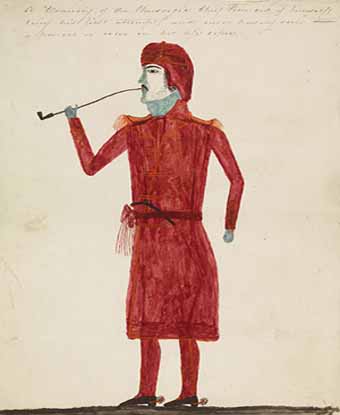
The Prophet Josiah Francis - self portrait
 In present-day Alabama, Colonel Andrew Jackson gained the nickname “Old Hickory”, and national fame, when he defeated the Red Sticks, Creeks who refused the “American way of life”, at the Battle of Horseshoe Bend in 1814. The resulting Treaty of Fort Jackson, ceded much of the Creek territory in central, and southern Alabama, as well as southern Georgia, to the United States. Creek refugees began to move out of the new United States territory and into Spanish Florida, joining the Seminoles and Miccosukees. Following their defeat, the British interceded and revitalized the Red Sticks that had fled into the Floridas. Red Stick leader Josiah Francis had intended to surrender to U.S. forces, but after the British arrived with their support, the Red Sticks took back to the warpath.

In 1814, the War of 1812 was still raging between the United States and Great Britain. As the Spanish did not have the means to stop them, the English were in Spanish Florida meddling in the affairs of the Seminole and Creeks, as well as fugitive slaves who ran away to Florida from their American masters to the north. In 1804, an associate of John Forbes and Company, William Hambly, opened a store at Prospect Bluff on the eastern shore of the Apalachicola River, near present-day Sumatra in Franklin County. During the War of 1812, British Admiral Lord Cochrane ordered Captain George Woodbine to sail up the Apalachicola River to take over Hambly’s store at Prospect Bluff and to start handing out arms and supplies to their Creeks, Seminole, and maroon allies. He was ordered by the British government to recruit and train Indians and maroons into a military force to be used to invade the southern United States. The British built a massive fort at Prospect Bluff, which sat on a cliff overlooking the Apalachicola River. The fort had an earthen parapet fifteen feet high and eighteen feet thick, with a wooden stockade for further protection.

Several renegade Creeks had informed U.S. authorities that they planned on continuing the war against the Americans, a threat that put fear in the minds of American frontiersmen, who blamed the British for agitating the Indians. During the War of 1812, a very large group of Red Stick Creeks gathered at Pensacola. Fearing that the U.S. may attack the city because of this, the Spanish governor invited the British in to help protect the West Florida capitol city. From Prospect Bluff, Woodbine and Nicholls sailed to Pensacola and occupied the city in September of 1814. After around seven-hundred Creeks and Seminoles came to their aid, Nicholls decided to send Woodbine with a hundred marines and three-hundred Indians to attack the American Fort Bowyer at Mobile Point. Unfortunately for the redcoats, General Andrew Jackson had recently re-garrisoned Fort Bowyer and was prepared to defend it. The British attack on Fort Bowyer was repelled, and they fled back to Pensacola suffering thirty dead and forty wounded. U.S. casualties were four dead, five wounded. Jackson wasted no time in pursing the limping British to Pensacola with a force numbering around four-thousand. In early November of 1814, Andrew Jackson seized Pensacola. The British left Pensacola, and Jackson headed for New Orleans, where he would gain great fame after the defeat of the British during the Battle of New Orleans in 1815.

After the British were driven out of Pensacola by Jackson, they returned to Prospect Bluff on the Apalachicola River. After the War of 1812 ended in February of 1815, the British left the Gulf of Mexico all together, except for Lieutenant Colonel Edward Nicolls in West Florida. Nicholls ordered for the fort on Prospect Bluff to be strengthened, and stocked with cannon, muskets, and ammunition. The fort consumed two acres, built in a square with its ramparts and parapets strengthened by wood and earth. The British placed nine to twelve cannons to be mounted on the fort, as well as several mortars and howitzers. Inside the massive fort were several houses and barracks made of stone. A group of three-hundred runaway slaves, or maroons, and Creeks, Seminoles, and Miccosukees were issued red British military coats. The British still aimed to use the native peoples and maroons as a military force, and intended to give them the fortification, arms and ammunition, in order to keep harassing Americans across the border.

Nicolls drafted a treaty for the Creeks and Seminoles in Florida that stated Great Britain would recognize the Florida Indians as an independent nation, allies of King George, and they would continue to supply them with arms and goods. In return, the Indians were told to cut all ties to the United States and Spain, and to consider them their enemies. Nicholls then began to write threating letters to U.S. Indian Agent Benjamin Hawkins, stating that any American effort to survey the lands acquired by the United States, via the Treaty of Fort Jackson, would be met with Indian violence. Hawkins considered Nicholls’s activities in Florida a violation of the Treaty of Ghent, the treaty that ended the War of 1812, and he informed Nicholls that British aggressors along U.S. border, such as himself, would not be allowed.[2]


The Destruction of the Prospect Bluff Fort
In the summer of 1815, the British government ordered Nicholls to withdraw from Florida. But, even after his departure, Americans living near the Florida border still complained about Indian raids killing their cattle and stealing their horses. Spanish citizens in Florida also launched several complaints about British officers in Florida. Before Nicholls departed from Fort Prospect, he turned the fort over to the Indians and maroons. By 1816, the maroons had farms surrounding the fort, which extended for miles along the Apalachicola River.[3] Under the leadership of a maroon named Garcon, around three-hundred and fifty people occupied, what white Americans referred to as the “negro fort.”
The prospect of an armed slave rebellion frightened slave owners in the United States, and once they heard that a garrison from the “negro fort” had attacked and killed a group of American sailors, General Andrew Jackson decided the fortification must be destroyed. Jackson felt it was Spain’s duty to eradicate this fort, and on April 23, 1816, Jackson wrote to the Spanish Governor of West Florida, Mauricio de Zuniga, notifying him that “the principles of good faith which always insure good neighborhood between Nations require the immediate and prompt interference of the Spanish Authority; to destroy or remove from our frontier this Banditti, put an end to an evil of so serious a nature, and return to our citizens and the friendly Indians inhabiting our Territory those Negros now in the said fort and which have been stolen and enticed from them….I reflect that this Banditti’s conduct will not be tolerated by our government and if not put down by the Spanish Authority will compel us in self Defense to destroy them.”[4] Zuniga replied to Jackson on May 26, that West Florida did not have the means to take on the expedition; that “I cannot act unless I receive the orders of my Captain General and the necessary Supplies, in order to undertake the Expedition with the probable prospect of ending it successfully.” Jackson did not like Zuniga’s reply, and in a letter pinned to Brigadier General Edmund P. Gaines on April 8, he authorized the destruction of Fort Prospect.

Gaines then ordered Colonel Duncan Lamont Clinch, with the help of the friendly Creeks under the command of William McIntosh, to build an encampment, just north of the Florida-Georgia line, on the banks of the Flint River. Gaines named it Camp Crawford and planned on supplying it via New Orleans, which meant a supply ship would need to enter the Apalachicola River from the Gulf of Mexico, and would have to pass Fort Prospect in order to reach Camp Crawford. This would allow the U.S. Army to keep their eyes on the Fort Prospect, and if the fort happened to fire on them, they had an excuse to destroy it. That scenario is exactly what happened in late July of 1816.

Colonel Clinch, with a force of about two-hundred and fifty men, including one-hundred and fifty Lower Creeks, who were friendly to the US, marched down the banks of the Apalachicola River to meet a supply ship and protect its passage through the area. By July 10, the supply ships had arrived and were waiting for Clinch at the mouth of the Apalachicola River. Once Colonel Clinch neared Prospect Bluff, his troops were fired on, which prevented his march to continue. Clinch decided to request gunboat support for the march. The U.S. met the gun boats at Fort Prospect, and had two warships position themselves across the river from the fortification. The Americans asked Garcon for a parley, but the fort’s leader stated that he would destroy any vessel flying the American flag. The two sides then began exchanging fire. The fort’s cannon kept missing the American vessels due to the fact that the men were not very well trained in artillery practices. The American warships began to fire hotshots, cannon balls that were heated to a glowing red.

The destruction of the fort on Prospect Bluff (Negro Fort)
 The ninth hotshot managed to land directly in the fort’s powder magazine, and the resulting explosion leveled the fort, killing two-hundred and seventy men, women, and children instantly, and wounding sixty-one. Red Stick Creeks and their Seminole allies would later blame the John Forbes and Company employee William Hambly for pointing out to the Americans the location of the powder magazine. It is said that the explosion could be heard in Pensacola, over a hundred miles away. The Americans then stormed the ruins, taking everybody who was not dead prisoner, and into slavery, claiming that the people of Georgia owned their ancestors. A number of black leaders were handed over to the U.S. friendly Creeks to be tortured and killed.[5] Garcon himself was executed by firing squad.

           The U.S. Army returned to Camp Crawford, having accomplished the goal of destroying the free-black stronghold. A biographer of Andrew Jackson, James Parton, wrote this about the destruction of the Negro Fort: “Seldom in the horrow-laden history of war, has a single ball been charged with such a mission to destroy as that which then rushed from the cannon’s mouth…An explosion, as of a hundred thousand cannons, shook Florida. The Negro Fort in an instant was a mass of smoking ruins, covering heaps of human beings of every age- dead, dying, mangled, shrieking. No words can describe the scene, nor does it need description. No imagination is too torpid as not to be able to conceive at once all its thousand horrors.”[6] Realizing that the defensive position of Camp Crawford required a longer presence of troops, Clinch ordered a more permanent fort be built in that location and named it Fort Scott.

Sources used:

Belko, W. S. (2011). Epilogue to the War of 1812. In W. S. Belko, America's Hundred Years' War: U.S. Expansion to the Gulf Coast and the Fate of the Seminole, 1763-1858 (pp. 54-102). Gainesville: University Press of Florida.

Moser, H. D., Hoth, D. R., & Hoemann, G. H. (1994). The Papers of Andrew Jackson, Volume IV, 1816-1820. Knoxville: The University of Tennessee Press.

Remini, R. V. (2008). Andrew Jackson: A Biography. New York: Palgrave Macmillan.


Dailey, R. C., Morrell, L. R., & Cockrell, W. (n.d.). The St. Marks Cemetery.


[1] Belko, p.55
[2] Ibid p.64
[3] Ibid. p.71
[4] Jackson to Zuniga, April 23, 1816, The Andrew Jackson Papers V.4, p.22-23
[5] Remini, p.137
[6] Dailey, Morrell, and Cockrell, The St. Marks Cemetery, p.9

Friday, January 18, 2019


The Second Spanish Period
1784-1821
Part Seven

William Augustus Bowles – Part Six


Artist interpretation of a 19th century Seminole village

Bowles’s Second Siege of San Marcos

William Augustus Bowles’s second siege on Fort San Marcos began in January 1802. This time, however, the fort was in better shape than it was in 1800, and had a larger garrison. Also, two warships at the fort’s wharf offered additional protection. On top of that, the engineer Perchet, who was there overseeing repairs to the fort, had a chain stretched across the San Marcos River to prevent enemy vessels from using it.[1] With Bowles recently receiving more supplies from a New Providence merchant ship, he was feeling bold. Bowles and his men, including his Indian allies numbering in the hundreds, camped not far from the fort and harassed it at all hours of the day. A solider named Juan Dozal, who had ignored the fort’s rules about venturing out to far, was captured by the Seminoles. At the same time, two Seminoles approached the fort offering to sale meat. DuBreuil had them locked up  in the fort as spies.

On January 6, Seminoles opened fire on San Marcos and the fort returned fire, as well as the galleys anchored in the river. The Seminoles escaped back to their camp, which they set up just out of shot range of the fort. DuBreuil found out that the captured soldier Dozal had been taken to Lake Miccosukee, and that the Seminoles there wished to do a prisoner exchange. DuBreuil said that he would accept the exchange, only if the Seminoles also gave up two Spanish soldiers who had deserted the fort some time before and were living with the Seminoles at Miccosukee. The Seminoles did not accept the counter offer and began to move in closer to the fort. DuBreuil ordered the advancing, hostile looking Seminoles to be fired on. The Seminoles fled and withdrew back out of range of the fort’s cannon, but they were not finished. A Creek named Topahuaique, who was a secret courier for DuBreuil, was ordered to scout the enemy’s camp. The many campfires could be seen from the fort, and Topahuaique went to investigate. Without getting close enough to be discovered, the scout reported back to the fort that one of the fires had at least 150 men camped near it.

            DuBreuil had plans for a sneak attack on the Seminole encampment, but assuming they were well supplied, in the way of arms and ammunition from the Bahamas, and after his scout told him that they were large in numbers, he abandoned it. The Spaniards had not yet seen Bowles, but the fact that the Seminoles were using posted guards at their camp, something Indians were not known to do, suggested that there were Europeans with the Seminoles, perhaps even leading them. Fort San Marcos was not at full strength, and DuBreuil even heard that some Seminoles were guarding the rivers entrance in the bay. At five o’clock in the afternoon, on January 12, 1802, a group of Indians, with a small group of white men, placed a red flag at the edge of the woods on the land side of the fort. Angered by this, DuBreuil ordered two warning shots from the fort’s cannon, as well as from a galley anchored in the river. The next day, a schooner called Eugenia entered the mouth of the St. Marks River from Apalachee Bay, on its way to resupply the fort, and the galley Luisiana was sent to protect it as it floated towards San Marcos. The Eugenia ran aground in the shallow channel of the St. Marks River, and had to wait for the tide to rise the next day to free itself. In the meantime, the Luisiana anchored by it to help keep it safe from Indian attacks.       

            The next morning, soldiers in the fort could see Indians on the other side of the river heading towards the Eugenia. Another galley, the Felipa, was sent downriver to help the Luisiana protect the Eugenia. The Seminole had entrenched themselves in a position where they could fire on any boat entering the St. Marks River. On January 14, the Felipa, with Engineer Juan Maria Perchet and twenty of San Marcos best soldiers aboard, headed toward the Seminole’s trenches, and opened fire, sending them fleeing for safety in the woods. The galley Luisiana and the schooner Eugenia, returned safely to the fort, and anchored. The soldiers on the Felipa then went ashore and destroyed the Seminoles earthworks by filling in the trenches and pulling up the protective pine logs and throwing them into the river. They then set fire to all the surrounding vegetation, leaving a smoke screen to cover their return to their ship. While the Felipa was returning to the fort it fired one more cannon shot towards the Seminoles in the woods.

            Around the time Perchet returned from his foray against the Seminole fortifications, DuBreuil had received a message from Bowles given to him by Indians bearing a white flag of truce. In the letter, which proved Bowles’s involvement in all this, the “Director General” again put out forth the prison exchange proposal, the captured soldier Dozal for Miccosukee villagers being held in Fort San Marcos’s jail. DuBreuil decided not to recognize Bowles as their leader and began to work on a letter to Chief Kinache of Miccosukee instead. The supply ship Eugenia had come bearing much needed supplies for the fort, but it also came with the news that the war between Spain and England was over. DuBreuil wanted to let the Seminoles know that they could no longer expect anything from the British.

            The next day, the Felipa went down river to check and see if the Seminoles had repaired their earthworks, which they had a bit. The men went ashore and destroyed the fortifications again. By January 16, 1802, DuBreuil had finished his letter and sent it under white flag to the enemy encampments in the woods not far from the fort. He again stated in the letter that he would only exchange prisoners if the Seminoles turn over the two Spanish deserters they had with them. They must have not have liked the idea because the tense situation between the Indians and the Spanish at San Marcos continued. When Pedro Rousseau arrived at the fort with two more galleys, the Seminoles slowly began to withdraw back to Lake Miccosukee. William Augustus Bowels again escaped the Spanish, and soon moved his headquarters from Lake Miccosukee to Estiffanulga, located on the Apalachicola River, in present-day Liberty County. Bevasue the Spanish were much better prepared, Bowles's second siege of Fort San Marcos de Apalache was a failure.


Peace at San Marcos and the Capture of William Augustus Bowles

Because Bowles moved out of the immediate area, the Spanish at Fort San Marcos were able to enter into peace negotiations with the Seminoles at Miccosukee and smaller surrounding villages. In August of 1802, Creek and Seminole chiefs traveled to Fort San Marcos to meet with DuBreuil, and a peace treaty between the Indians and the Spanish was established, which ended hostilities between the two. The white flag of truce was lowered from the fort’s flagpole, the Spanish banner raised, and fifteen celebratory cannon blasts then echoed throughout the area.[2]

The Treaty of Apalache ended the war between the Seminoles and the Spanish at San Marcos. Most important to San Marcos was article five of the treaty, stating “The Florida Indians, and particularly the Mesasuques (Miccosukees), and their chief, Captain Micko Kinache, obligate themselves not to lend aid, direct or indirect, guards or auxiliaries, to the adventure William Augustus Bowles, and not to trade with him since he has been the cause and moving spirit of all hostilities which have occurred; and they shall leave this adventurer to his fate, taking notice that this article will form the essential base of the treaty.”[3] Spanish and Indian relations were now mended for the most part, but Bowles was still receiving small amounts of supplies from pirates who managed to get through the watchful eye of Spanish galleys patrolling the Gulf Coast.

In November of 1802, William Augustus Bowles, and his few remaining followers, journeyed to Tampa Bay to commandeer any vessel they could get their criminal hands on. While attempting to capture a vessel, four of Bowles’s supporters were killed in a gunfight, including Chief Kinache’s brother. That was the life of a pirate. In February of 1803, one of Bowles’s former supporters told the Spanish that he was currently on the Steinhatchee River. Taking fourteen soldiers, Lieutenant Ramon de Uribe left San Marcos de Apalache on a skiff and headed east down the Gulf coast towards the Steinhatchee River. On the Steinhatchee, Uribe and his men spotted Bowles and a few followers on a pirogue in the middle of the river. This was it. The time was now. Uribe was about to capture the criminal Bowles that had so often escaped Spanish grip. Or so he thought.

Once Bowles noticed the Spanish approaching, he and his men began to throw everything overboard and then jumped into the river themselves, swimming to shore and fleeing into the woods. Once again the rascal Bowles was gone, but so was all his supplies. Despite Spanish victories against Bowles, he was still on the lam, and therefor still a problem that needed to be dealt with. Ignoring the Treaty of Apalache, a few of Bowles's followers who remained in Apalachee fired sporadically at Fort San Marcos until early 1803. In March, a company of grenadiers was sent from Pensacola to San Marcos, bolstering its garrison to one-hundred soldiers.

            As 1802 became 1803, Bowles was extremely weakened. His support from the British in the Bahamas was gone, most of his Seminole allies had left him, and his pirates were failing him miserably. In March of 1803, United States Indian Agent Benjamin Hawkins informed Folch in Pensacola that Bowles had moved his camp across the boundary into U.S. territory.[4] Bowles began to desperately search for new recruits among the Upper Creeks, where he again promised goods that he could not deliver. But by now his words were mostly falling on deaf ears. Nevertheless, Bowles was planning to speak at Hickory Ground, a Creek village near present-day Wetumpka, Alabama. Many villages were invited to hear him speak, and by May 22, Upper and Lower Creeks, including the Seminoles, Chickasaw, Cherokee, and the Choctaw nations arrived at Hickory Ground. Hawkins was there, and planned on arresting Bowles, but wanted his seizure to be done by the Indians. Folch believed that letting the Indians seize Bowles, rather than the Spanish or Americans, was the best way to deal with him, and calm the tribes.[5]

            In the spring of 1803, the Spanish heard word that Bowles was in the southernmost Upper Creek villages, (in Alabama) trying to bolster his ranks. While in that area, Bowles summoned chiefs Little Prince of Ofooche, Micco Tucoches of the Seminoles, and Mislogue, the one-time prisoner at Fort San Marcos. The chiefs all refused to speak with him. Although Bowles was having a difficult time finding new followers, he still vowed to war on the Spanish, and drive out any Spaniard or American living within Creek lands. Growing more and more desperate to find friendlies, Bowles began to tell the natives that he had twenty-five fully stocked ships waiting for him off the Gulf Coast, but this new lie did little to garner him any new support. Bowles then returned to Kinache at Miccosukee, and told him that he had gained the support of several Lower Creeks, which was another lie, and Kinache welcomed him which was a clear violation of the Treaty of Apalachee. An Indian assembly was coming up soon, the Council of the Four Nations, and Bowles and his Seminole allies planned to go. Also planning on going were the anti-Bowles Seminoles, who wanted to arrest Bowles if their chiefs allowed them to do so.

            Spain and the United States were also invited to send representatives to the meeting. Folch sent his son, Esteban Folch, to represent Spain, and Benjamin Hawkins represented the United States. The congress of the Upper Creeks, Lower Creeks and the Seminoles, Chickasaws, Cherokee, and Choctaw was to be held at Hickory Ground, near Wetumpka, Alabama (which is not far from present-day Montgomery) on or close to May 20, 1803. Either Bowles was actually foolish enough to attend a meeting surrounded by his enemies, or he may have been forced to go by chiefs he thought were his allies but were really planning on arresting him. Many Lower Creeks, and a large faction of Seminoles, longed to end the warfare and misery Bowles had brought them, and expel him without creating inter-tribal fighting.[6] Most of what we know about Bowles’s capture comes from John Forbes, the successor of William Panton and his company, who was present and kept notes about the meeting.

            Esteban Folch and Benjamin Hawkins both arrived to Hickory Ground on Saturday May 21, 1803. Over that weekend, Indians slowly entered the village, and by Monday, word was out that Bowles and chiefs from Seminole and Lower Creek towns would arrive the next day. On Tuesday, May 24, Bowles, being only a few miles away, dispatched runners to arrive before himself to procure quarters for him and the chiefs. The Creek chief Hopoy Micco, leader of the upcoming council, agreed to provide a residence for Bowles. Folch and Hawkins planned on arresting Bowles on sight, and went to Hopoy Micco to receive approval to do this. Hawkins told Hopoy Micco that he regarded the Seminoles with Bowles as hostile, and asked that he keep him informed on to what the council planned to do with Bowles. Hawkins was not sure whether he or the chiefs were going to arrest Bowles, though he was more than happy to do it, Hawkins did not want to anger the Seminoles, and provoke a violent reaction, so he preferred that the chiefs made the capture. Hopoy Micco then informed Hawkins that the chiefs would indeed arrest Bowles themselves.

            When Bowles arrived at Hickory Ground, he was not allowed to attend the council of chiefs. For the rest of the day, May 26, the chiefs discussed Bowles cautiously, without even using his name. Hopoy Micco secretly met with Seminole chief, Efau Hadjo, an ally of Bowles. Unfortunately we do not know the exact details, but Hopoy Micco must have talked the Seminole leader into betraying Bowles. In the afternoon of May 26, after the gathered chiefs summarized their talks, the day ended with tribal ceremonies. In his journal, John Forbes wrote about how impressed he was with the secrecy displayed regarding the talks about Bowles. Bowles and his friends had no idea the danger they were in. After being barred from the council talks, a couple of chiefs, Topalca and Noumatimatla, persuaded Bowles to attend a feast, and he happily agreed to go.

            Once Bowles arrived to the “feast”, he was suddenly seized by Indians and put in chains. He was then put in a boat bound for Mobile. On the way to Mobile, Bowles and his guards camped out on a small island. In the middle of the night, the famously slippery Bowles wriggled out of his chains, found a small boat and fled his captors. When his Indian guards woke up and found Bowles missing, they hurriedly searched for him and, lucky for them, found him not far and easily recaptured him. That would be the last time William Augustus Bowles ever escaped custody. On June 7, 1803, Bowles arrived at Mobile, and three hours later he was on his way to New Orleans. On June 13, Governor Salcedo had his son transport Bowles to Havana, Cuba, where he was to be imprisoned at El Morro Castle. In New Orleans, Governor Salcedo held a ceremony to award those who brought Bowles to justice.

             Because Bowles had managed to escape custody several times in the past, the Spanish decided to put him in solitary confinement, which made him become depressed. He was forced to realize he would never create the independent State of Muskogee, or lead it as Director-General. The man had committed terrible offenses against the Spanish in Florida. He had declared war on Spain, captured and held Fort San Marcos, as well as Spanish vessels, killed and injured Spanish subjects, destroyed Spanish property, and provoked the Indians to commit terrible acts, which then lead to deplorable conditions for them. In El Morro Castle, Bowles began to starve himself to death. His health faded fast and he was taken to a military hospital, but they were unable to save him. William Augustus Bowles died on December 23, 1805.


El Moro Castle - Cuba
Sources used:

Din, G. C. (2012). War on the Gulf Coast: The Spanish Fight Against William Augustus Bowles. Gainesville: University Press of Florida.


Kinnaird, L., & Kinnaird, L. B. (1983, July). War Comes to San Marcos. Florida Historical Quarterly, Vol.LXII, No.1, pp. 25-40.


[1] Din, p.177
[2] Ibid. p.198
[3] Kinnaird, p.42
[4] Din, p.207
[5] Ibid. p.207
[6] Ibid. p.209

Thursday, January 17, 2019


The Second Spanish Period
1784-1821
Part six

William Augustus Bowles – Part Five


Flag of Muskogee

The Retaking of FortSan Marcos de Apalache

It would be weeks before the Spanish commanders at Pensacola made a move to retake San Marcos from William Augustus Bowles and his allies. Once the ships San Marcos de Apalache and the Aquiles reached Pensacola with the evacuees from Fort San Marcos, Lieutenant Governor Vincente Folch questioned the men on what had happened and was convinced that Tomas Portell was a cowardice fool who let a handful of Indians with no artillery take a well-fortified Spanish fort. The fact is that the fort was never that well-fortified, the troops were beginning to run out of supplies and were nearly starving, and Bowles did have his hands on some artillery. Folch demanded that Portell report to Fort San Carlos and turn himself in as a prisoner. Folch then sent Governor Caso-Calvo a letter blaming Fort San Marco’s surrender on Portell and his officers, but promised a quick recovery.

Surprisingly, on June 10 a canoe arrived in Pensacola bearing men with valuable information. The men had escaped from Bowles, and were mostly Panton’s Wakulla employees. They told Folch that Fort San Marcos was currently only manned by Bowles and a few of his hired mercenaries, and that the majority of his Indian allies had abandoned the fort and returned to their respective villages. Their count was twenty Indians, eighteen blacks and twenty-one whites. They also informed Folch that Bowles was planning on using the captured Sheerwater as a pirate ship to terrorize the Spanish. With this news, Folch told his officers that he was going to lead a mission to recover the fort. He set up a council of war in the Pensacola Government House to discuss their next move. Once the fort was reconquered, Captain Pedro Olivier was to be the next Commandant of San Marcos. Folch requested forty days of rations, and ordered the Treasury Official to prepare his ships for the voyage to San Marcos. Folch and his men, on nine ships, left Pensacola on June 18, 1800. Aboard the Hawk, Folch used a map of San Marcos to draw up his plan to retake the fort. Meanwhile at San Marcos, Bowles knew the Spanish would come back, and he relied on their procrastination while he wrote letters to Georgia, New Providence, and Jamaica for assistance against the Spanish, but he never received any.[1]
As Folch was readying for his unauthorized expedition to recover San Marcos, the Governor of Louisiana and West Florida, Marques de Caso-Calvo, was preparing a mission of his own. He was unaware that Folch had took it upon himself to lead an expedition to San Marcos, and called for 250 troops to take the fort. The governor instructed Lieutenant Colonel Zenon Trudeau to be the overall commander of the expedition, and Lieutenant Colonel Pedro Rousseau to be in command of the ships and their crew. Trudeau and the fleet of thirteen vessels with nearly 400 men sailed for San Marcos on June 24. About a week later, Caso-Calvo found out that Folch was leading his own expedition to San Marcos. Caso-Calvo was angered by Folch’s audacity, but did not recall Trudeau and Rousseau. The Trudeau-Rousseau fleet reached Mobile Bay and spotted a British pirate ship, which sent out two launches to investigate the Spaniards. The fleet moved closer into Mobile Bay, and the launches returned to their ship, but not before firing off a few shots in the Spaniard's direction. This event frightened Trudeau, as his fleet only had one gunboat, so he anchored in Mobile Bay and requested an escort from Pensacola to help them. The acting commandant of Pensacola while Folch was gone was Francisco de Paula Gelabert, and as soon as Trudeau’s request reached him he sent the Havanero to assist. With help from the Havanero, the Trudeau-Rousseau expedition reached Pensacola on July 14.

While Caso-Calvo was still organizing the Trudeau-Rousseau expedition, Folch and his fleet arrived in Apalachee Bay late in the day of June 22. Folch then distributed maps to his men, and by three o’clock in the morning of June 23, they were ready to make their move upriver. By the time the sun rose, the fleet had reached the mouth of the San Marcos River and continued upstream. The heavy Hawk was forced to remain in the bay, probably near Spanish Hole, so Folch boarded the Leal. From the Leal, he dispatched a messenger to the fort under a white flag of parley. The messenger boarded the ship’s launch and began rowing towards the fort, as the fleet followed slowly behind him. As soon as someone from the fort spotted the messenger, Bowles had a cannon fire three warning shots in his direction, causing him to retreat back to the fleet. Not long after the messenger returned to the Leal, one of Bowles’s messengers arrived from the fort at the ship under a white flag. Bowles’ messenger apologized for the warning shots, and then allowed Folch’s messenger to proceed to the fort to ask for its surrender. The fleet followed slowly behind.

The courier reached the fort and awaited Bowles’s reply. Meanwhile, Folch had his fleet anchor just out of range of the fort’s artillery. When the messenger finally returned to Folch with Bowles’s refusal to surrender, he lowered the white flags of parley and raised the Spanish banners and commenced to shelling the fort. The fort’s cannons on the southern side facing the river fired back. This continued for hours until a cannon ball from the Venganza managed to strike one of the fort’s cannons, destroying it. Another shot, this time from the Tetis, struck the fort itself destroying a merlon and a small portion of the stone wall. These explosions scared off the rest of Bowles’s Creek and Seminole followers from the fort, and his white mercenaries followed them. Their departure from the fort assured a Spanish victory.[2]

Bowles knew this would eventually happen, that is why he kept a saddled horse inside the fort at all times. He also kept a few small sailing vessels on the San Marcos River on the east side of the fort. Bowles boarded one of these vessels and departed up the San Marcos River towards Lake Miccosukee as the Spanish fleet was nearing the fort. By the time they reached the wharf, Bowles was gone. Folch had Lieutenant Colonel Jacobo DuBreuil inspect the fort, and by five o’clock in the afternoon, the flag of Muskogee was lowered and the Spanish banner was once again raised over Fort San Marcos de Apalache. The Spanish did manage to capture a few of Bowles’s men, but Bowles himself had gotten away from Spanish authorities yet again. By the next morning, Folch sent the Venganza and the Tetis up the San Marcos River in pursuit of Bowles. After roughly a ten-and-a-half mile trip up the San Marcos River, just a few miles from Natural Bridge, the ships spotted four small crafts along the river’s edge. Bowles and his men were sleeping, and some were eating, when they spotted the Spanish vessels, at which point they fled into the woods, leaving everything behind. The captured vessels were towed to the fort, but unfortunately, Bowles escaped once again, and took refuge with Seminoles living along the northern reaches of the San Marcos River, and Lake Miccosukee, a mere thirty miles from the fort.

Folch remained at San Marcos until July 11, to make sure everything was in order before he left. He named Olivier the new Commandant of San Marcos, and ordered him to rebuild the fort’s lime kiln, replace the destroyed limestone blocks, repair the wooden stockade, and fix the parapet of the bombproof. Folch also recommended a retractable staircase be built to the bombproof’s roof, in the case of an enemy entering the fort they could continue resistance from up top. Olivier was a great choice, because the fort was under constant alarm from possible Indian assaults, and Olivier was good friends with the Creeks, so the Spanish government hoped his appointment would ease the tense situation.

 Before he left to return to Pensacola, Folch ordered the stone watchtower on the other side of the Wakulla River to be dismantled. While still at San Marcos, Folch received a letter from Bowles stating he was just trying to establish neutral ground between his State of Muskogee and the Spanish. He also requested the return of this Muskogee flag. Folch thought about how to reply to Bowles for days. He finally sent a letter back to Bowles, apologizing for not answering sooner, and stating that he had been sick for days, which was a lie. Folch invited Bowles to the fort for a talk. But, learning from his past mistake after being captured this way before, Bowles declined.

Before finally returning to Pensacola, Folch had the area’s Indians gather at the fort, where he planned on giving them a stern talking to. He told them to quit following the deceiver Bowles and if they did not, Folch promised to destroy their villages. The Spanish found out that at a meeting the Upper Creeks held nearly a year before, they denied ever having a white man as their chief, or even having a “director general.” The Upper Creeks claimed they would have killed William Augustus Bowles, had it not been for his Seminole protectors around Lake Miccosukee.[3] With this new information, the Spanish now had proof that Bowles was just a fraud, who did not deserve any honorable treatment.


The Continued Search for William Augustus Bowles

After Folch retook San Marcos from Bowles, the Spanish set out to locate him, but also to repair relations between the Creeks/Seminoles and themselves. Throughout the summer of 1800, sickness swept through San Marcos, causing thirty soldiers to fall ill in one month, and the fort’s hospital was not prepared for it. On top of that, Olivier had gotten word from a friendly Creek that Bowles and the Seminoles of Miccosukee planned a new attack on San Marcos for late July. By the time Governor Caso-Calvo’s Trudeau-Rousseau fleet made it to Pensacola, Folch had already returned victorious from San Marcos. After Folch in Pensacola got word of Bowles’s new planned attack on the fort, he sent Rousseau to San Marcos to help put down any attack Bowles and the Indians may attempt. Folch then sent a message to the Seminoles stating that Bowles was just a con-man who took five weeks to take San Marcos, and only an hour-and-a-half to lose it. Folch told the Seminoles to leave Bowles and to not fight against Spain “because it will end in your total ruin. Remember, you are but a handful of poor ignorant people who are to be feared only when hidden in the thickness of the forest, from where we shall drive you out with our artillery and other weapons unknown to you.”[4]

As the Spanish were trying to get chief Kinache of Miccosukee to submit to them, Bowles was trying to acquire a ride back to the Bahamas to gather more supplies and reinforcements to recapture the fort. During this time, the Seminoles rejected the Spanish and remained loyal to Bowles. Even U.S. Indian Agent Benjamin Hawkins tried to persuade them away from Bowles, but to no avail. The Upper Creeks even sent emissaries to Miccosukee to scold the Seminoles, but they just turned a deaf ear to them. Bowles had severely brain washed the Seminoles in believing in him.

When Folch learned that Nassau merchant John Miller was again readying ships and supplies for Bowles, he told Rousseau to keep an eye out for such vessels during his voyage to San Marcos. Rousseau’s fleet left Pensacola on August 2, and after some wind delays, reached San Marcos on August 6. On August 15, several Seminoles fired on boats heading up the San Marcos River to gather fresh water for the fort. A sailor was killed, and soldiers were immediately dispatched from the fort to aid the boats that were under attack. The soldiers managed to chase off the warriors, but the fighting would not end there. Trudeau had no doubt that the hostile Seminoles came from Miccosukee, about thirty miles north, and decided to gather a large force for an attack on that village.

On August 17, 1800, Trudeau, and a force of 272 men, began their march from San Marcos to Lake Miccosukee. However, they did not make very good progress. They halted and set up camp after marching less than three miles. Around four o’clock in the morning, they resumed the march. But, by eleven o’clock in the morning, the men were drenched in sweat, exhausted, and thirsty. By noon, a few men became ill so they decided to stop and camp for the rest of the day. Trudeau called off the expedition when he realized he was moving to slow for a surprise attack on the Seminoles. The climate and terrain had defeated them. They turned around and returned to San Marcos on August 19.

             In late August, Olivier was ordered to be replaced by Captain Jacobo DuBreuil, and with the departure of Lieutenant Colonel Trudeau, the fort begun to deteriorate. DuBreuil took command of the fort on September 22, and soon after complained about his soldiers in a letter to the new Governor Manuel de Salcedo, stating that they were “the most useless soldiers, the most vicious, and the most persistent in their object of avoiding duty”.[5] At this time, the fort was protecting two Mississippi River galleys, the Luisiana, and the Felipa, and soldiers were ordered not to venture to far outside the wall of the north side of the fort, where the Seminoles were most likely to attack.

 On September 2, 1800 Captain DuBreuil ordered twenty-five soldiers to go clear some palmetto bushes not far from the fort. When they reached the bushes they were suddenly ambushed by the Seminoles. They managed to kidnap one of the workers, but shrapnel from one of the fort’s cannon balls succeeded in taking down several Seminoles. The Seminoles now knew that they really did not have to fear Spanish military operations, as they were mostly ineffective. The Spanish found out that Bowles was no longer at Miccosukee, and that he had gone to East Florida to plunder for supplies. He was nearly caught by some Spanish dragoons, but dove into the St. Marys River to save himself once again from capture. For the next few days, Bowles was hungry and on the run, until he reached the home of a friend on the Flint River. His failure in East Florida had made some of the Seminoles weary of Bowles. The Seminole chief Kinache no longer allowed Bowles to enter his house, and he was forced to stay with the black Seminoles, or maroons.

By October, the threat from Bowles and the Seminoles began to die down. During the week of October 21 – October 29, several groups of Indians congregated in the woods north of the fort and presented a white flag of truce. Chief Timayolt of the Tallahassee Seminoles spoke on behalf of the group. They wanted to atone for their offences, realizing now that Bowles was just an insane man that fooled the Seminoles in believing he could provide them with cheaper goods. Timayolt promised that they would never again war against “their old Spanish friends.”[6] Bowles’s actions had made the Seminoles and Creeks poor and miserable. They had no harvest in 1800, and because of their actions, were deprived of Spanish goods. Since one of DuBreuil’s main goals at San Marcos was to reestablish the Seminole-Spanish relationship, he accepted their apology, but implored them to talk Chief Kinache of the Miccosukee Seminoles to help capture Bowles. The Indians did not come empty handed. Timayolt brought with him several head of cattle for the fort, which La Camarona helped him secure. In a gesture of good will towards the Seminoles, DuBreuil handed out rations to all the Indians there, which was nearly numbered four-hundred. The rations consisted of bread, rice, meat, tobacco, salt, and liquor. However, DuBreuil told them that peace and trust could not be completely reached until the Indians produced Bowles to the Spanish authorities.

In Decemberof 1800 , just before the new year, a chief from the Lower Creek village of Kasihta arrived at Fort San Marcos. He wanted to find out what the Seminoles were doing, and if Panton had any plans of re-opening the Wakulla store. The Wakulla store’s factor was a man named William Hambly. Hambly told the chief that without peace, neither Panton nor the Spanish government would resume trade with the Indians. In January of 1801, William Panton himself came down with a serious illness in Pensacola. He was now suffering financially and physically, and on February 26, 1801, William Panton died. Soon, Panton’s company became the John Forbes Company. Unfortunately, in March of 1801, the Seminoles of Miccosukee again became belligerent towards San Marcos. A guard at the fort noticed a group of Indians attempting to rustle the fort’s cattle that were grazing in a field on the north side. The fort’s cannon did not scare them off, so DuBreuil sent thirty soldiers to rescue the cattle. After being chased by the Spanish for three miles, the Seminoles gave up on the cattle and left them.

U.S. Indian Agent Benjamin Hawkins
In June of 1801, U.S. Secretary of War Henry Dearborn authorized Indian Agent Benjamin Hawkins to do whatever he could to apprehend Bowles, should he cross into U.S. Territory. Throughout the summer, Seminoles from Miccosukee skirmished often with the soldiers from the fort. One such instance, on July 12, DuBreuil ordered eight soldiers to chop some firewood for the fort. Just as soon as the men reached the wooded area, the sounds of Seminole war cries could be heard, as well as gun fire. Six men were able to make it back to the fort. As soon as they entered the fort’s gates, thirty more soldiers went out to pursue the Miccosukees. They managed to chase them off, and discovered the seventh soldier hiding in the river. Unfortunately, they found the eighth soldier shot and scalped. In the middle of July, Governor Caso-Calvo was replaced by Colonel Manuel Juan de Salcedo. Meanwhile in Apalachee, the John Forbes Company pulled out of Wakulla, closing its doors for good. It had not been in operation since 1800, the second time Bowles seized it. Continuing to try to persuade Miccosukee to give up Bowles, in August, DuBreuil got the Tallahassee Seminoles to agree to join villagers who lived in San Marcos to journey to Miccosukee and convince them to turn Bowles over to the fort, and reestablish peace so trade could once again prevail. Unfortunately their talks with Miccosukee would be to no avail.

On September 4, three sailors from the fort was fishing downriver on the San Marcos, when they were suddenly attacked with musket fire. One of the soldiers jumped into the river and swam back to the fort to get help. Sailors were dispatched to search for the other two men, but only found one who had been wounded in the attack. DuBreuil was furious. He stated if the Seminoles were not punished soon, they would eventually pick off his entire garrison one by one. In October, DuBreuil once again had a message for Miccosukee. He told them that the punishment for murder was “a head for a head.” At this point in time, the Indians had killed at least fifteen people since Bowles’s arrival to the area two years earlier. DuBreuil told them he did not want fifteen Indian heads, just Bowles’s. He told them to turn Bowles over and no Indian would be harmed. He reminded them that Bowles had obstructed their hunts, their farming responsibilities, and had forced the Wakulla store to close.

Back in Pensacola, the new Governor Salcedo wrote to U.S. Indian Agent Benjamin Hawkins expressing an intense desire to capture or kill Bowles. Salcedo told Hawkins that their two nations ought to combine strength to bring the pirate down. Also in October, the engineer Juan Maria Perchet finally made it to San Marcos to inspect the fort. He concluded all wooded structures, as well as the stone wall be repaired. Approval from the governor to do so would not arrive until March 1802.
Back on March 21, 1801 DuBreuil received some news about Bowles’s whereabouts. He had heard that a merchant ship from New Providence was spotted near the Steinhatchee River, where Bowles apparently established a new trading post. DuBreuil sent a detachment to the Steinhatchee, where they spotted Bowles’s boat, and pursued it. Once his boat reached land, Bowles and his cohorts fled into the wilderness. However, DuBreuil learned that Bowles returned to Steinhatchee in May, where he and Kinache, the chief of Miccosukee, had a poorly constructed fort built. DuBreuil decided to send a couple of Indians to spy on them. A few days later, after destroying the small fort, the spies returned to San Marcos and divulged to DuBreuil that Bowles was now back at Miccosukee, and he had received supplies from a cargo ship at Steinhatchee.

To be concluded in William Augustus Bowles Part Six (of Six)...


Sources used:


Din, G. C. (2012). War on the Gulf Coast: The Spanish Fight Against William Augustus Bowles. Gainesville: University Press of Florida.

Kinnaird, L., & Kinnaird, L. B. (1983, July). War Comes to San Marcos. Florida Historical Quarterly, Vol.LXII, No.1, pp. 25-40.


[1] Din, p.134
[2] Ibid. p.136
[3] Ibid. p.140
[4] Ibid. p.144
[5] Kinnaird, p.37
[6] Din, p.154