Thursday, January 24, 2019


The Second Spanish Period
1784-1821
Part Eleven


General Jackson Comes to Florida

On December 26, 1817, Secretary of State John C. Calhoun gave the order to General Andrew Jackson to go to Fort Scott and take command of the district. He told Jackson that he would command 800 U.S. Army Regulars, and 1,000 Georgia militiamen. His goal was to chastise the Seminoles, who were believed to number around 2,700, and remove the source of Indian hostilities, which were the British in Spanish Florida. In a letter dated January 6, 1818, Jackson wrote to President Monroe that he should take Florida from the Spanish and if allowed to, he could conquer Florida in sixty days. Because Monroe did not take immediate action after receiving this letter, he essentially gave Jackson the authority to do just that. Monroe would later claim that he told Calhoun to write to Jackson, telling him not to attack any Spanish installations, but either Calhoun never wrote the letter, or Monroe never actually asked him to.[1] After receiving his orders, Jackson wrote to eight different officers who had served with him before in the Creek War, and asked them to raise a group of Tennessee volunteers to march with him to Florida. Jackson left his home, the Hermitage, on January 22, 1818, headed for Fort Scott in Georgia just north of the Florida line. As he traveled through Tennessee, men eager to fight for Jackson volunteered and joined him along the way.

From Tennessee, General Andrew Jackson and his men made their way to Hartford, Georgia where he met up with General Gaines. Jackson’s force then reached Fort Scott on March 9. They had marched 450 miles in 46 days, a very quick pace, especially considering that they marched through rain and muddy roads along the way. Now his army consisted of 800 U.S. Army regulars, 1,000 Tennessee volunteers, 1,000 Georgia militiamen, and around 1,400 friendly Lower Creek warriors, who were under the command of Brigadier General William McIntosh, a Creek chief. Jackson sent McIntosh and his Creeks to make a military observation of the west bank of the Apalachicola River. On March 19, McIntosh reported that he captured an Indian village called Red Ground on the banks of the river without firing a shot. 180 women and children were captured, but thirty men and their chief had escaped.

Jackson reviewing his troops
Jackson reviewed his troops, and on March 10, 1818, the force left Fort Scott to meet up with American supply vessels heading up the Apalachicola River from New Orleans via the Gulf of Mexico. Marching along the east side of the river, the army spotted the vessels of Captain Isaac McKeever who provided the men their dinner for the night. The troops arrived at the ruins of the “Negro Fort” on Prospect Bluff on March 15. The soldiers could still see debris and charred remains from the 1816 explosion, just two years earlier.[2] Here the men rested as they waited for more supply vessels. In a letter to the Secretary of War, Jackson wrote that, “The eligibility of this spot, as a depot, determined me, and I immediately directed my Aid-de-camp Lieutenant (James) Gadsden, of the Engineer Corps, to furnish a plan for, and superintend the erection of a, Fortification. His talents and indefatigable zeal displayed in the execution of this order, induced me to name it Fort Gadsden, to which he is justly entitled.”[3]  In August of 1818, Jackson wrote that Fort Gadsden was a temporary, hastily built wooden fort, which without constant repair, would not last five years. Around this time, Duncan McCrimmon, a young Georgia militiamen, idiotically wandered away from the safety of Fort Gadsden to go fishing. While he was trying to return to camp, he got lost and was captured by a group of Red Stick Creek warriors who were attempting to gather intelligence on Jackson’s movements. The unlucky McCrimmon was taken to Francis Town on the banks of the Wakulla River to be interrogated and executed.


Milly Francis pleading for McCrimmon's life to be spared
The Red Sticks questioned McCrimmon on the size, ability, and goal of Jackson’s army, after which, his execution was prepared. One of the warriors desired to exact revenge on any American soldier available, for the killing of his sister, and the unfortunate McCrimmon was good enough for him. The leader of this village was Josiah Francis, better known as the Prophet, or Hillis Hadjo, the religious leader of the Red Stick movement within the Creek nation, who had fought against Jackson before, or “Sharp Knife”, as the Red Sticks called him, because he cut them deeply. Josiah Francis’s daughter, Milly Francis, around fifteen years old, heard the commotion of the upcoming execution of young McCrimmon and pleaded for her father to show mercy. The Prophet told her that he could do nothing about it because Creek law allowed people to take revenge, but he asked her to plead with the warrior in charge of the execution for the life of McCrimmon. Young Milly did just that, and by telling the warrior that this death would not bring back his sister, he was moved by her humanity, and decided to spare McCrimmon from death. Soon after, McCrimmon was traded to the Spanish authorities at Fort San Marcos for seven and a half gallons of rum.

The March towards Tallahassee and Miccosukee

On March 25, 1818 the second American supply vessel finally arrived at Prospect Bluff with eight days of rations. It would have to be enough because the army was soon to march to Miccosukee.[4] Jackson ordered Captain McKeever to take his boats out into the Gulf of Mexico and anchor at the mouth of the San Marcos River, in Apalachee Bay. Jackson had heard that several men who were wanted by the United States were guests of the Spanish at San Marcos. They were Josiah Francis, Peter McQueen, Alexander Arbuthnot, and George Woodbine. Jackson wanted to make sure they could not escape by boat when his army approached the fort. On March 26, leaving a garrison behind at Fort Gadsden, Jackson and his army headed northeast to the Miccosukee villages, crossing the flat pine-lands and swamps of present-day Liberty County. After three days of marching, the army reached the Ochlocknee River on March 29. Early the next morning they crossed the river at a point now called Jackson Bluff and set up camp for the day. Jackson expected reinforcements to arrive from Tennessee and allied Creek Indians under the command of Brigadier General William McIntosh to add to his numbers very soon.

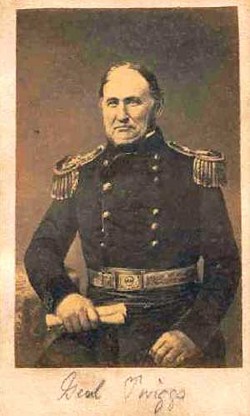
Jackson sent Major David E. Twiggs ahead of the main body, with two-hundred allied Creeks, to try and surprise the Seminole towns of Tallahassee and Miccosukee, and other smaller surrounding towns. Twiggs entered Tallahassee on March 31, found it abandoned and burned it to the ground. The Seminoles had heard about Jackson’s army, and fled into the nearby woods. From the Ochlocknee River camp, Jackson continued toward Tallahassee, and his topographical engineer, Hugh Young, wrote “there was a small miry branch (a boggy area) near the village, the town (Tallahassee) was handsomely situated on a hill and consisted of ten or twelve houses with a large clearing cultivated in common.” Today, the hill that Young spoke of is located where the Tallahassee Mall used to be.

Brigadier General William McIntosh
Jackson’s march resumed, pretty much following the course of present-day State Road 20, entered the Red Hills of Florida, and camped along a pond located four miles west of the Miccosukee villages. The encampment seems to have been the lowlands along West Tharpe Street, about four miles west of North Monroe Street, where there may have been a pond, once upon a time. Before nightfall that day, Jackson caught back up with Twiggs, but still did not have his Tennessean reinforcements, or McIntosh’s Creeks. The army set up camp, but were awoken by Jackson at midnight to continue the march to Miccosukee and punish the Seminoles. Soon a rider entered Jackson’s camp informing him that his Tennessee Volunteers and McIntosh’s Creeks had finally arrived. He then decided to delay the attack on Miccosukee.

Jackson instead sent a detachment ahead to scout Miccosukee, where they spotted several Seminoles herding cattle. The army continued east, heading towards Miccosukee, which was the same village that allied themselves with William Augustus Bowles eighteen years earlier. On April 1, 1818, Jackson’s men reached a point of land that extended into a swamp, about one and a half miles away from the Miccosukee village. Here, the Miccosukee had dug in and prepared for a fight, and Jackson’s forces began to encircle them. Gunfire was exchanged, but when some Tennesseans fired on their allied Creeks by mistake, the Seminoles were able to escape during the confusion. The casualties of the battle were fourteen dead Miccosukee, and one dead American. U.S. forces marched on to the main village located on Lake Miccosukee, and found it deserted as well.

Angry, Jackson began a methodical hunt for other villages. General Jackson wrote, “The pursuit was continued through the Mekasukean Towns, until night compelled me to encamp my army. The next day Detachments were sent out in every direction to reconnoiter the Country, secure all supplies found, and reduce to ashes the villages. This duty was executed to my satisfaction: nearly 300 houses were consumed, and the greatest abundance of corn, cattle, &c. brought in.”[5] After burning the main village of Miccosukee to the ground, Jackson’s army visited six other villages, the locations of each were later given to Florida Governor William Pope Duval in 1824 by Tallahassee Seminole chief Chefixico. They were Canhallahatchee, at the head of the western branch of the St. Marks River, Tapalga on Tallinhatchee Creek, Allikhadgee on the St. Marks River just north of St. Marks Spring (near Natural Bridge), Ben Burgess’ town on Lake Ayavalla, present-day Lake Jackson, Lochiochee near the Georgia border, and Estotulga, also near the Georgia border.[6]

Jackson was furious that the Seminoles kept escaping him, and he felt that the British were somehow involved, since they were in the area conducting trade with the Indians. Andrew Jackson hated a lot of things, and the British were number one on that list. Jackson, again, had his army burn the village to the ground, but not before stealing 1,000 head of cattle, and 300 bushels of corn. Jackson wrote that “every indication of a hostile spirit was found in the habitations of the chiefs. In the council house of Kinhaje’s (Kinache’s) town, king of the Miccosukee Seminoles, more than fifty fresh scalps were found, and in the center of the public square, the old Red Stick standard, a red pole was erected, crowned with scalps, recognized by their hair, as torn from the heads of the unfortunate companions of Scott.” The body of Kinache was found, ending his forty-year reign over Miccosukee.

The soldiers forded the shallow Lake Miccosukee and attacked a small group of Seminoles, killing one black man and three Indians, one of which was wearing an American military uniform that he must have gotten off the body of a murdered soldier from the Scott Massacre.[7] Jackson believed that the Seminoles were being guided, armed, and helped by the British, which he alleged the Spanish allowed, so he turned his army southward towards the fort at San Marcos de Apalache. Jackson wrote, “From information received from Pensacola and New Orleans, I have no doubt that St. Marks is in possession of the Indians. The Governor of Pensacola (Jose Masot) informed Captain (Richard Keith) Call, of the 1st Infantry, that the Indians had demanded arms, ammunition, and provisions, or the possession of the Garrison at St. Marks, of the Commandant, and that he presumed possession would be given from inability to defend it.”[8] The captured wife of Chief Chenubbee, who was also a captive of Jackson’s army, said that the Seminoles had obtained their ammunition from St. Marks, so Jackson was adamant about relieving the Spanish of the fort and using it for his own depot.  

Sources used:

Remini, R. V. (2008). Andrew Jackson: A Biography. New York: Palgrave Macmillan.

Heidler, D. S., & Heidler, J. T. (1996). Old Hickory's War: Andrew Jackson and the Quest for an Empire. Mechanicsburg, PA: Stackpole Books.

Moser, H. D., Hoth, D. R., & Hoemann, G. H. (1994). The Papers of Andrew Jackson, Volume IV, 1816-1820. Knoxville: The University of Tennessee Press.

Kilgore, J. (19--). Old St. Marks in Florida: An Historical Work.


[1] Remini, p.141
[2] Heidler and Heidler, p.137
[3] General Jackson to the Secretary of War, Head Quarters, Division of the South, Fort Gadsden, East Bank of the Apalachicola River, formerly  
      Negro Fort, 25th March, 1818
[4] Heidler and Heidler, p.140
[5] General Jackson to the Secretary of War, Head Quarters, Division of the South, Camp near St. Marks, 8th April, 1818
[6] Kilgore, p.19
[7] Heidler and Heidler, p.143
[8] General Jackson to the Secretary of War, Head Quarters, Division of the South, Fort Gadsden, East Bank of the Apalachicola River, formerly  
      Negro Fort, 25th March, 1818

Wednesday, January 23, 2019


The Second Spanish Period
1784-1821

Part Ten

First Seminole War – Battle of Fowltown and the Scott Massacre

Chief E’ne’he’maut’ly (Neamathla)
General Edmund P. Gaines, now at Fort Scott on the Flint River, having sent Lt. Richard W. Scott down the Apalachicola River to see Major Muhlenburg and the supply vessels safely to the fort, dispatched a friendly “Indian runner to notify the foul-town Chief E’ne’he’maut’ly (Neamathla) of my arrival, and, with a view to ascertain whether his hostile temper had abated, requested him to visit me – he replied that he had already said to the Commanding officer here (Major David E. Twiggs) all he had to say, and that he would not come.”[1] Neamathla was not happy that the Americans had built a fort so close to his land. He was also extremely angry about the destruction of Fort Prospect, as some of his friends and relatives had been killed in the explosion. To the Americans, the Treaty of Fort Jackson ceded all Creek land in Georgia to the U.S., but the people of Fowltown did not consider themselves Creek, and therefor did not abide by the treaty.

 On November 20, fed up with Neamathla, Gaines ordered a force of two-hundred and fifty soldiers under the command of Major David Twiggs to march to Fowltown and arrest the chief. Gaines wrote to Jackson on the 21st of November, “I yesterday detached [2]50 men (supposes to be the strength of the town) under the Command of Major Twiggs, with orders to bring me the Chief and warriors and in the event of resistance to treat them as Enemies.”[2] Twiggs and his troops left Fort Scott on the evening of November 20, marching and crossing the Flint River in the cover of darkness, arriving at Fowltown around sun rise on the morning of November 21. The residents of Fowltown were just waking up and were sitting around their campfires, wrapped in blankets, when the troops began to attempt to surround the village, to try to prevent an escape. Some of the town’s warriors noticed what was happening, and opened fire on the Americans. The villagers began to flee in panic, and Twiggs ordered his men to fire, and with a single volley, they sent the Indians into the surrounding swamp.

Gaines wrote to Jackson, “the fire was briskly returned by the detachment, and the Indians put to flight, with the loss of four warriors slain…It is with deep regret I have to add that a women was accidently shot with some warriors in the act of forcing their way through our lined formed for the purpose of arresting their flight. The unfortunate women had a blanket fastened round her (as many of the warriors had) which amidst the smoke in which they were enveloped, rendered it impossible as I am assured by the officers present, to distinguish her from the warriors.” After the attack, American troops discovered a British red uniform coat in Neamathla’s house, as well as a letter from Lieutenant Colonel Edward Nicolls, stating that the chief “has always been a true and faithful friend of the British.”[3] Twiggs marched his men back to Fort Scott, arriving back on the night of November 21.

Gaines was not happy with the outcome of Twiggs’s sortie. As he saw it, Neamathla had openly engaged with American troops on American soil. As far as the United States was concerned, Neamathla had just started a war. Gaines decided to attempt to end this war quickly. The next day, November 22, General Gaines sent Lieutenant Colonel Matthew Arbuckle, now with three-hundred men, to again try to arrest Neamathla. The Americans again crossed the Flint River and followed the path to Fowltown. After daybreak on November 23, the troops reached Fowltown, this time discovering the village completely abandoned.

Angry at the prospect of failing yet again to arrest Chief Neamathla, Arbuckle ordered his men to load up a wagon with corn found stored in the town. The men were loading the corn, when suddenly war cries were heard, as musket after musket discharged in the direction of the troops. Neamathla and about sixty of his warriors emerged from deep in the woods and began defending Fowltown. Arbuckle had his troops return fire. This situation continued for about twenty minutes, when suddenly the warriors fled the village as quickly as they had appeared. It is thought Neamathla gave up because they ran out of ammunition. Gaines wrote to the Secretary of War on November 26, 1817, “…I a few days past detached Lieutenant Colonel Arbuckle with three hundred officers and men. The colonel reports that the Indians had placed themselves in a swamp, out of which about sixty warriors made their appearance near the town, and, with the war-whoop, commenced a brisk fire upon our troops, which they returned in a spirited manner. The fire continued but for fifteen or twenty minutes, when the Indians were silenced, and retired into the swamp with a loss which the colonel estimates at six or eight killed, and a greater number wounded. We had one man killed and two wounded.”[4]

As the smoke cleared, eight dead warriors were discovered, while American casualties were only one killed, a young man named Aaron Hughes, and three wounded. Now a bit rattled after the surprise attack, the men were ordered to continue loading the wagon. The troops soon left Fowltown, heading back to their crossing at the Flint River. Once they reached the river, Arbuckle felt that it was a good idea to construct a small fort on that side of the river, to keep an American presence in that area. In three days, the troops constructed a small blockhouse surrounded by a small palisade. Arbuckle named it Fort Hughes, after the first American slain in the Seminole wars, and the young man was interned there.

 The Americans managed to force the Red Sticks out of Georgia, and into Spanish Florida, some traveling to Lake Miccosukee and what the Seminoles called Tallahassee Taloofa, or “Old Field Town”, present-day Tallahassee. At the Miccosukee Towns, along the western shore of present-day Lake Miccosukee, Neamathla and his people explained what happened at Fowltown to Chief Kinache, as well as well-known chiefs from the surrounding areas, such as Peter McQueen, Homathlemico, and Josiah Francis who had villages along the Wakulla River. Red Stick Creeks and the Seminoles in Florida were outraged about the attack on Fowltown, and large war parties from Lake Miccosukee to the Suwannee River, and villages in between including Francis Town, or Prophet Town as some called it, began to walk to the Apalachicola River to cut off the U.S. supply route to Fort Scott. The First Seminole war was underway.

Nine days after the American attack on Fowltown, angered Red Sticks, Seminoles, and their maroon allies, attacked Lieutenant Scott’s vessel as it was rowing back up the Apalachicola River towards Fort Scott. A few days before, General Gaines had sent Lt. Scott down the Apalachicola River with a detachment of men to assist Major Muhlenburg in bringing supplies up the Apalachicola River to Fort Scott. When Scott finally found Muhlenburg at the mouth of the Apalachicola River, Muhlenberg was disappointed that Gaines had only sent one boat, as the major wanted to lighter his load on them. He had been unable to ascend the river because his ships were too heavy and the water was too low. During the voyage from Mobile Bay to Apalachicola Bay, several of Muhlenberg’s men aboard his ships came down with a sickness, and desperately needed to reach Fort Scott soon to get some medical attention. Unaware that the First Seminole War had just began, Muhlenberg ordered Scott to load his boat with the sick, and take them immediately to Fort Scott.

The major replaced the twenty of the lieutenant’s able-bodied men with sick, unarmed soldiers. Also on board Scott’s boat were seven of the soldier’s wives and four children, as well as regimental clothing for the garrison. Before Scott began to ascend upriver towards Georgia, Muhlenberg gave him a letter to deliver to General Gaines, requesting more boats to help him get the supplies to Fort Scott. Scott’s party on the Apalachicola River rowed past the landings of friendly Creek towns on the western shore of the river. They spotted some Indians on the eastern shore, but they did nothing. Major Muhlenburg had ordered Scott to make a stop at Spanish Bluff, near present-day Blountstown, where the Forbes Company employees Edmund Doyle and William Hambly lived. When the U.S. destroyed the Prospect Bluff Fort in 1816, the Red Sticks and Seminoles blamed William Hambly for pointing out to the Americans where the fort’s powder magazine was located, allowing the U.S. to turn the fort into a crater. To the Red Sticks and Seminoles, Hambly was an enemy and a wanted man.

Chief John Blount
Hambly’s and Doyle’s homes were located in present-day Bristol, Florida, across the Apalachicola River from Chief John Blount’s town, now present-day Blountstown. John Blount was a chief from an Upper Creek town who escaped the Creek War of 1813-1814, by leaving Alabama and settling along the Apalachicola River in Spanish West Florida. At first, Blount allied himself with the British at Prospect Bluff, but when the British left Florida after the War of 1812, Blount allied himself with the United States, but also tried to keep good relations with Red Stick leaders such as the Prophet Josiah Francis, Homathlemico, Peter McQueen, and Neamathla. When Lieutenant Scott’s party arrived at Spanish Bluff, Doyle and Hambly summoned Blount to cross the river and meet with Scott.[5]

Blount arranged for Major Muhlenberg’s letter to be delivered on foot to General Gaines at Fort Scott. Lieutenant Scott had no idea that a war had begun with an attack on Fowltown, and was surprised when Doyle, Hambly, and Blount informed him. They urged Scott to wait at Spanish Bluff for the messenger to reach General Gaines at Fort Scott, and for the reinforcements to arrive at Spanish Bluff. They told Scott that Red Sticks, Seminoles, and their black allies were converging on the Apalachicola River, and were determined on not allowing American vessels to pass. Scott decided to send a message of his own with Muhlenberg’s letter to Gaines, writing from Spanish Bluff on November 28, 1817, “Sir, Enclosed you will receive Major Muhlenberg’s communication, which he directs me to forward to you express from this place. Mr. Hambly informs me that Indians are assembling at the junction of the river, where they intend to make a stand against those vessels coming up the river; Should this be the case, I am not able to make a stand against them. My command does not exceed forty men, and one half sick, and without arms. I leave this immediately… Note – The bearer of this is entitled to three dollars on delivering this letter. The Indians have a report here that the Indians have beaten the white people. ”[6]

For reasons we will never know, Lieutenant Scott decided to go against Doyle, Hambly, and Blount’s warnings to wait for reinforcements at Spanish Bluff. Instead, he got back on his boat, and continued up river. It is believed by some that perhaps Scott thought they would meet Gaines’s reinforcements on the river way before he reached the junction, where the Indians were waiting to attack him.[7] Nevertheless, on November 28, 1817, Scott sealed his fate, and the fate of his men, by continuing upriver against all warnings.

On November 30, 1817, nine days after the attack on Fowltown, the supply boat under the command of Lieutenant Richard W. Scott was sailing up the Apalachicola River, in route to Fort Scott. A large number of Indians had fanned out for 150 yards along the Apalachicola River, about a mile below the juncture of the Chattahoochee and Flint Rivers that form the Apalachicola. Seeking revenge for Fowltown, a force of Creek and Seminole warriors, under the leadership of Chief Homathlemico, attacked the boat, which contained forty soldiers, seven women, and four children. Only six soldiers survived the attack, four of them were wounded, but they managed to make it to Fort Scott. The women were taken and executed by the Indians, except one, Elisabeth Stewart, who was taken to the Suwannee River villages, called Bowlegs Towns. All four of the children were grabbed up by their heels, and had their brains smashed out by Indians banging their heads on the side of the boat.[8] When news of this tragedy reached Washington, General Gaines was ordered to lead an incursion into Spanish Florida to pursue hostile Indians. However, Gaines was in no way authorized to attack any Spanish installations. When the order came in, Gaines was away from Fort Scott because he was in East Florida helping to fight off pirates who had occupied Fernandina, and was not available.


[1] Gaines to Jackson, Nov.21, 1817, The Andrew Jackson Papers V.4, p150
[2] Ibid. p150
[3] Remini. p.76
[4] Gaines to Secretary of War, Nov. 26, 1817. ASPIA,v2, p.160
[5] Cox, Dale. The Scott Massacre of 1817, p
[6] Scott to Gaines, Nov.28, 1817. American State Papers, Military Affairs, Vol1. p.688
[7] Cox, Dale, The Scott Massacre of 1817, p
[8] Remini, p.139

Tuesday, January 22, 2019


The Second Spanish Period
1784-1821
Part Nine

Road to the First Seminole War


Representative image of items for sale/trade from the British to Florida Indians

Ambrister, Arbuthnot, and the Florida Indians

            Before Captain George Woodbine of the British Royal Marines departed from the Apalachicola River, he summoned Kinache, the British-friendly chief of Miccosukee who had once been allies with William Augustus Bowles, to a meeting in which he promised the chief he would return to Florida in a year. About a year later, the former governor of Georgia and new U.S. Indian Agent David Mitchell informed the U.S. Secretary of War “that a British agent is now among these hostile Indians, and that he has been sending insolent messages to friendly Indians and white men settled above the Spanish line.”[1]

In actuality, there were at least two British agents meddling in Florida in 1817, who were actively enticing the Indians to war on Americans. One was an elderly Scottish trader named Alexander Arbuthnot. Arbuthnot had been trading with the Creeks and Seminoles for some time from his base in the Bahamas, but he moved to Florida to replace John Forbes and Company in 1817. His activities in Florida were of great concern to the United States because Arbuthnot had basically became the new Nicholls. Arbuthnot wrote several letters to British officials requesting that the British government protect the Florida Indians. He requested arms and ammunition, as well as other supplies. He wanted to see all Creek lands that were taken via the Treaty of Fort Jackson returned to their rightful owners. The Creeks and Seminoles even gave Arbuthnot power of attorney, signed by twelve Creek and Seminole chiefs, many of whom were wanted men in the United States.[2] 

Brigadier General Edmund P. Gaines
Arbuthnot sent letters to American officials as well, stating that the British government would not tolerate Americans trespassing onto Creek and Seminole lands, including those taken in the Treaty of Fort Jackson, which was now a part of the United States. This made Alexander Arbuthnot a wanted man in the United States. In a letter from Muscogee chiefs to the King of England, the Indians requested that British officers should be dispatched to their lands to help fight American encroachment. “We have found and bled for him (King of England) against the Americans, by which we have made them our bitter enemies. Surely, then, he will not forget the suffering of his once happy children here.”[3]

The other British agent stirring up trouble in Florida was former officer Robert Ambrister. Ambrister, like Arbuthnot, frequently requested arms, ammunition, and supplies from the British government for the Indians to use to resist American encroachment along the Florida border. Arbuthnot and Ambrister were not working together, in fact Arbuthnot did not like Ambrister, but the United States just viewed the two as the new “Nicholls and Woodbine.”


Escalating Tensions
In 1817, the newspapers of Georgia were full of atrocities committed by Florida Indians. The Americans and the Seminoles did not like each other, and tensions were on the rise. American squatters, and outlaws, often raided Seminole villages, killing them and taking their cattle. This angered the Seminoles, and often young warriors would retaliate by stealing their cattle back. In February of 1817, a group of Seminoles attacked the isolated home of the Garrett family, located near the St. Mary’s River, just north of the Florida border in Georgia. While Obediah Garrett was away, who the Seminoles believed had earlier murdered one of their own, the Seminoles found his wife and two children, one a toddler, the other a baby, and shot and stabbed them to death, before they took their scalps.

“I received by the last weeks mail a letter from the Honble. Archd. Clark, Intendant of the town of St. Mary’s,” Brigadier General Edmund P. Gaines wrote Jackson, “which it appears that another outrage of uncommon cruelty and barbarism has recently been perpetrated on the southern frontier of Georgia. A party of Indians attacked a defenseless family and massacred a women (Mrs. Garrot) and her two children – the women and eldest child were scalped, the house robbed and set on fire.”[4] In the same letter, Gaines goes on to tell Jackson of a man named Alexander Arbuthnot. “I enclose also, a letter signed ‘A[lexander] Arbuthnott.’ This letter appears to have been written by one of those self-styled Philanthropists who have long infested our neighboring Indian villages, in the character of British Agents – fomenting a spirit of discord.”[5]

With already bad relations between the Americans in Georgia and the Seminoles, and Miccosukees, the murder of the Garret family only made matters worse. Once Americans learned of the Garrett murders, many of them sought vengeance on any Indian they came across near the Florida-Georgia border. However, let it be known that Georgians killed far more Florida Indians then the Indians killed Georgians. Gaines blamed the hostility on Kinache’s Miccosukee people and pinned the Seminole chief a letter stating “Your Seminole are very bad people…you have murdered many of my people, and stolen my cattle…but just give me the murderers and I will show them my law.”[6] Gaines goes on to warn the chief to stay away from Englishmen, and requested permission to enter their towns to retrieve “my black people”.

As you can imagine, Gaines’s letter to the Seminole chiefs greatly angered them. Chief Kinache responded by writing, “You charge me with killing your people, stealing your cattle, and burning your houses. It is I that have cause to complain about the Americans. Where one American has been justly killed while in the act of stealing cattle, more than four Indians have been murdered while hunting by those lawless freebooters. I harbor no negroes. When the Englishmen were at war with America (War of 1812), some took shelter among them; and it is for you white people to settle those things among yourselves, and not to trouble us with what we know nothing about. I shall use force to stop any armed Americans from passing my towns or my lands.”[7]

Chief Neamathla
After receiving the Kinache’s response, and infuriated by it, Gaines pinned another letter to General Andrew Jackson, dated October 1, 1817, which stated, “They (the Seminole chiefs) acknowledge the murder of a women (Mrs. Garret) and her two children- but justify the act upon the ground that the Warriors who committed the this outrage had lost friends, had entered our Settlements to take satisfaction, found at the house of Garret a kettle belonging to the Indians that had been killed, and therefore ‘Supposing the murder had been committed by the husband of the women.’ Killed her and her children… I am convinced that nothing but the application of force, will be sufficient to ensure a permanent adjustment of this affair. I shall therefor put the First Brigade in motion for Fort Scott as soon as I can possibly obtain transportation, and I trust that I shall at least by the 20th or 25th reach that place…My heavy supplies will go by water with suitable guards; the principle part of the force however will go by Land; and in any event we shall finish the new road, near one third of which is already completed. By a letter from Major (David E.) Twiggs the Commandant of Fort Scott, I learn that he had been warned, some weeks past, by the principle Chief (Neamathla) of the Fowl Town (fifteen miles above the Fort, and nearly twenty miles above the national boundary), ‘not to cut another stick on the East of Flint River,’ adding that ‘the land was his, and he was directed by the powers above to protect and defend it, and should do so; and it would be seen that talking could not frighten him’. Major Twiggs adds that he had not seen the Chief nor any of his people since he made the above threat, and that the Indians of this town alone had recently stolen and killed an hundred head of cattle in one drove. I shall confer with the agent upon the subject of punishing and removing out of our limits these disorderly Indians.”[8]

Map showing Major Muhlenburg's path from Alabama to Apalachicola Bay and the location of Fort Scott just above the Georgia line.
From Alabama, General Gaines, with a guard made up of troops from the 4th and 7th U.S. Infantry left for Fort Scott before the full force of the First Brigade. Before Gaines departed, he ordered Brevet Major Peter Muhlenburg, of the 4th Infantry, to proceed to Fort Scott from Mobile Bay with vital supplies. The water route forced him to sail down the Gulf Coast of Spanish Florida and up the Apalachicola River. Once Gaines arrived at Fort Scott, he was surprised that Major Muhlenberg was not already there. “I regret to be under the necessity of saying to you (General Jackson) that Major [Peter] Muhlenburg [Jr.] with the detachment and supplies sent around by water, has not yet arrived.”[9] Concerned for the supplies that were very badly needed at Fort Scott, General Gaines dispatched Lieutenant Richard W. Scott of the 7th Infantry with 40 soldiers to travel down the Apalachicola, to locate Major Muhlenburg and help him reach the fort safely. Gaines then turned his attention to the reason he was there, which was to chastise Chief Neamathla of Fowltown.

Sources used:

Belko, W. S. (2011). Epilogue to the War of 1812. In W. S. Belko, America's Hundred Years' War: U.S. Expansion to the Gulf Coast and the Fate of the Seminole, 1763-1858 (pp. 54-102). Gainesville: University Press of Florida.

Moser, H. D., Hoth, D. R., & Hoemann, G. H. (1994). The Papers of Andrew Jackson, Volume IV, 1816-1820. Knoxville: The University of Tennessee Press.


Remini, R. V. (2008). Andrew Jackson: A Biography. New York: Palgrave Macmillan.

American State Papers, Foreign Relations, Vol. 4. 1815-1822 - http://memory.loc.gov/ammem/amlaw/lwsplink.html


[1] Belko, p.73
[2] Ibid. p.74
[3] Remini, p.147
[4] Gaines to Jackson, April 2, 1817, The Andrew Jackson Papers V.4, p.106-107
[5] Ibid, p.107
[6] Gaines to Seminole chiefs, ASPFR.V4.p585-586
[7] Kinache to Gaines, ASPFR,V4.p.586
[8] Gaines to Jackson, Oct. 1, 1817, The Andrew Jackson Papers V.4, p140-141
[9] Gaines to Jackson, Nov. 21, 1817, The Andrew Jackson Papers V.4, p151